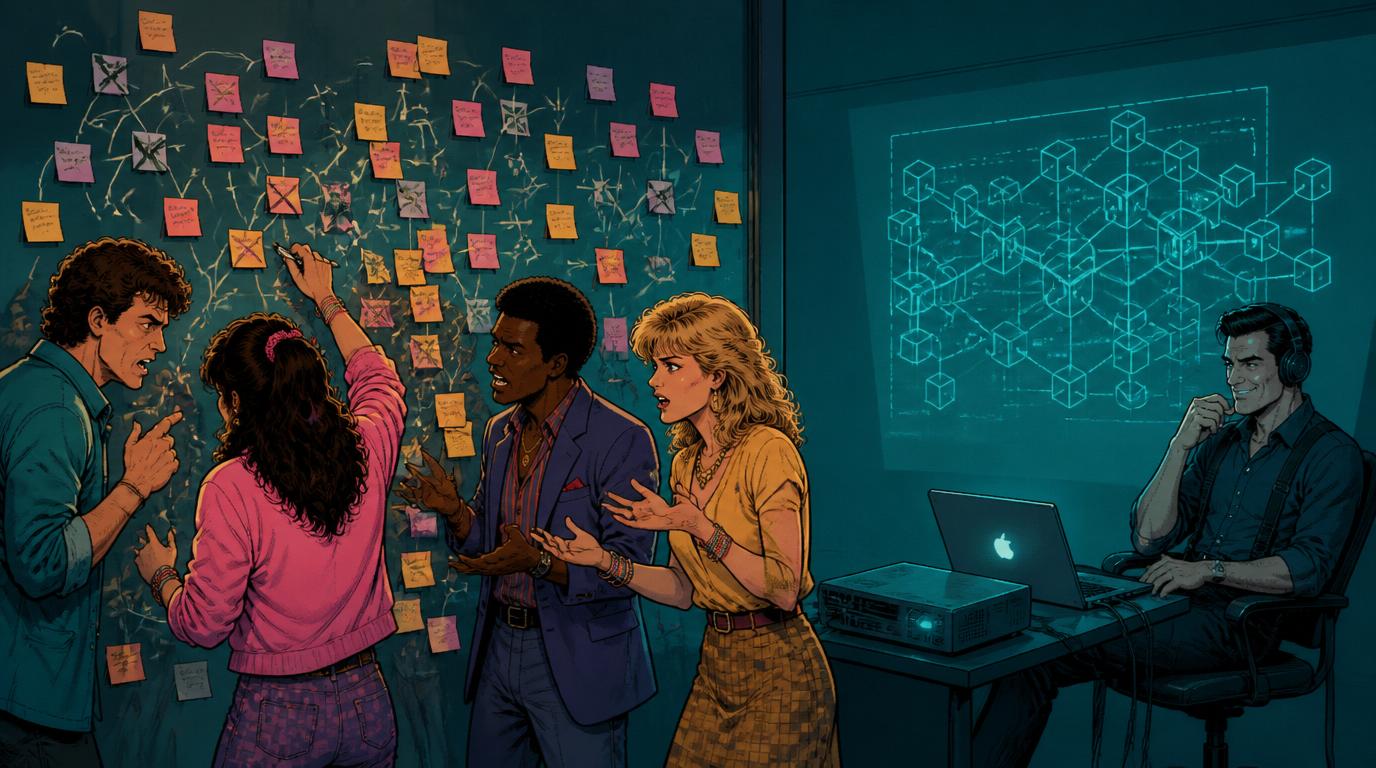
These artefacts are not the point of the workshop. They are a souvenir of the negotiation. The actual product is the argument that produced them - the shared understanding the team built by disagreeing, the commitment that now exists behind a framing that everyone argued their way into together. Throw away the sticky-notes and the value remains. Skip the argument though, and you just have some nice coloured stationary.
AI can fill in the canvas. It cannot fill in the room.
AI tools can now generate a set of How Might We questions, fill in a value proposition canvas, or map a plausible user journey - all in less time than it takes to make yourself a cuppa. These are all, structurally, the same activities that an innovation workshop is designed to produce. The artefacts arrive fast, coherent, and — this is the critical part — they look exactly like the real thing.The problem is that a workshop is doing two things simultaneously: creating the deliverable, and building the shared understanding of the team that produced it. A team that argued its way through a value proposition canvas for two hours internalised the value proposition. They also internalised the arguments against it, the alternatives they considered, and the reasons they discarded them. When a stakeholder challenges the framing later, they can defend it. When user research suggests they were wrong, they have the context to understand why.
I think of this as the shell artifact problem. The AI-generated canvas is formally identical to the one the team produced through a workshop. But it is a shell: it arrived without the negotiation that gave the human-produced version its weight. It has the right shape and nothing inside.
This has practical ramifications, as research on AI use in advertising agencies has shown that teams who used AI to generate finished artefacts, such as problem statements, user journeys or personas, found that subsequent stages of the process proceeded without the shared context that the workshop would have built. The misalignment then had to be re-negotiated later under time pressure. That cost shows up in another stage of the project, not during it, which is why it is easy to miss.
Putting the human into the process
Analysis of disciplined AI use in innovation contexts seems to be converging on a particular split between the human and AI role. A 2025 empirical study of AI-augmented sensemaking found that the most productive role for AI in collaborative work is as a question engine — something that surfaces material and produces creative tension between a group's current understanding and what the AI proposes — rather than as an answer engine that produces summary artefacts directly. When AI asks the room a question, the room does the integrative work. When AI answers the question for the room, the integrative work disappears and so does the understanding that would have come from it.Similarly, the study of advertising agencies use of AI, which I referred to earlier, found a parallel structure emerging across multiple organisations: a co-creative stage in which AI participates as a collaborative partner in generating ideas, followed by a distinct human-led validation stage that remains explicitly separate. The boundary between those two stages is, in their analysis, crucial. Remove it and the model stops working. AI in the co-creative stage, humans in the validation stage, and the distinction between the two held deliberately.
Not less AI, but more human
The practical implications of the shell artifact problem is not necessarily solved by using less AI. It is solved by being deliberate about where in the process AI produces and where humans integrate. In my experience, it is always useful discipline is to break AI use into specific, bounded tasks. For instance, generate ten user journey variants, produce three different framings of the problem, surface the assumptions buried in this value proposition — and to treat each output as a stimulus for the team's own deliberation, rather than as a conclusion. The team reviews, argues, selects, and synthesises. The AI widens the option set; the team owns the choice.The stages of an innovation process most vulnerable to the shell artifact problem are the ones that look most wasteful from a time-saving perspective: the two hours of argument over what the real problem is, the uncomfortable moment when someone says they do not believe the user journey, the team negotiation over which assumption to test first. These are exactly the stages where handing AI the synthesis feels most tempting and costs the most to do. They are where the work that matters is happening.
We are all still getting used to AI in RD&I, but the best innovation exercises I have seen use AI to expand what the team can survey and debate, while protecting the moments of genuine collective decision-making that turn a correct-looking artefact into one the team actually owns.
We need to make sure there is still a pearl of wisdom and not just an empty shell.
This is part of a series on AI in the innovation process. See also: 2: The Polish Problem | 3: The Synthetic Persona | 4: The Validation Gap | Problem 5: The Missing Apprentice